
The challenge
The Treasury and Finance Division at KMUTT oversees university-wide budgeting, disbursement, procurement, and accounting workflows, generating high transaction volumes daily. Previously, operational records were scattered across individual paper logs and disconnected spreadsheets. Division supervisors had limited visibility into real-time capacity and task backlogs, while staff faced exhausting multi-day scrambles at the end of every appraisal cycle compiling retrospective evidence for annual performance evaluations.
The solution
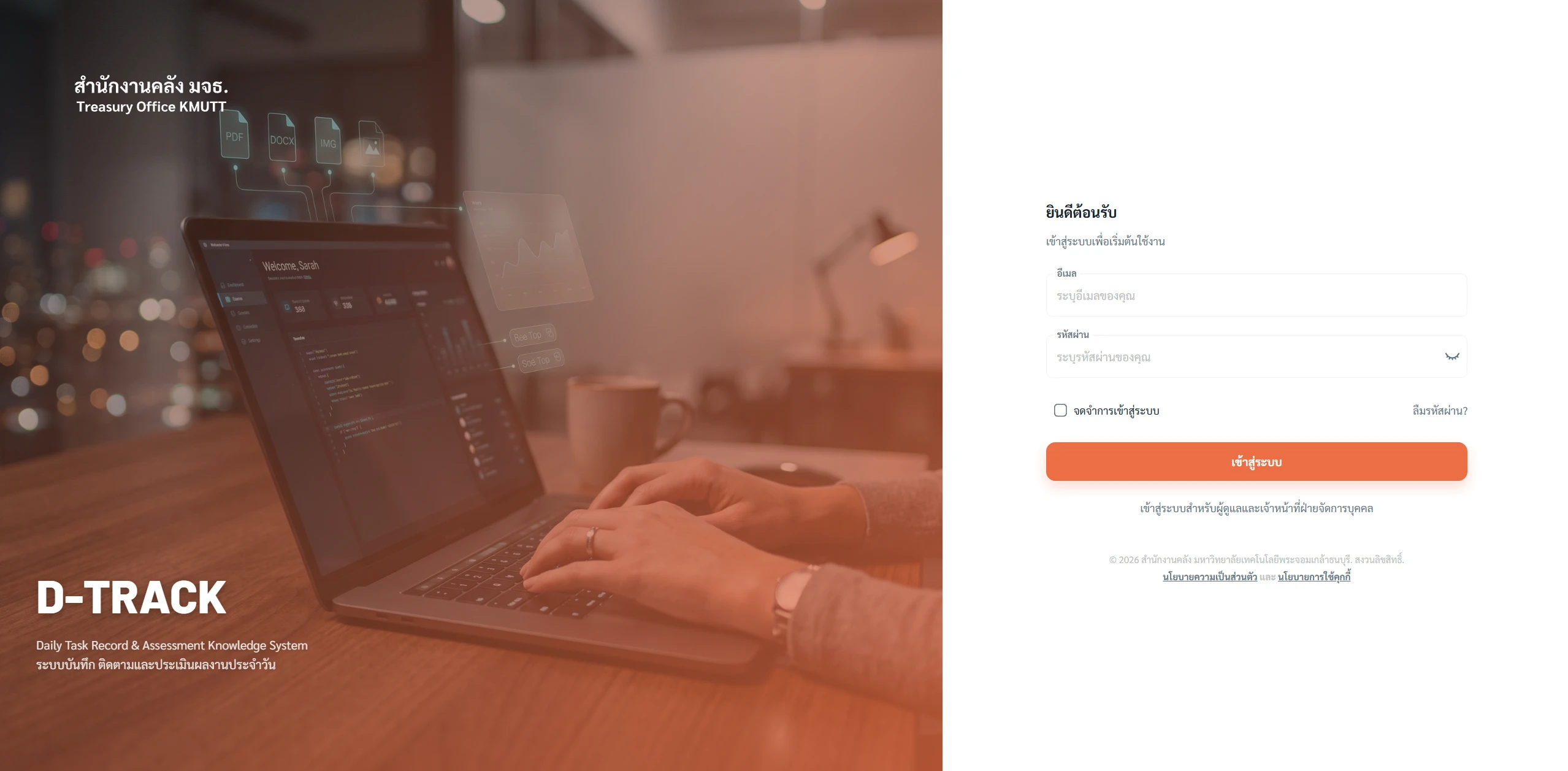
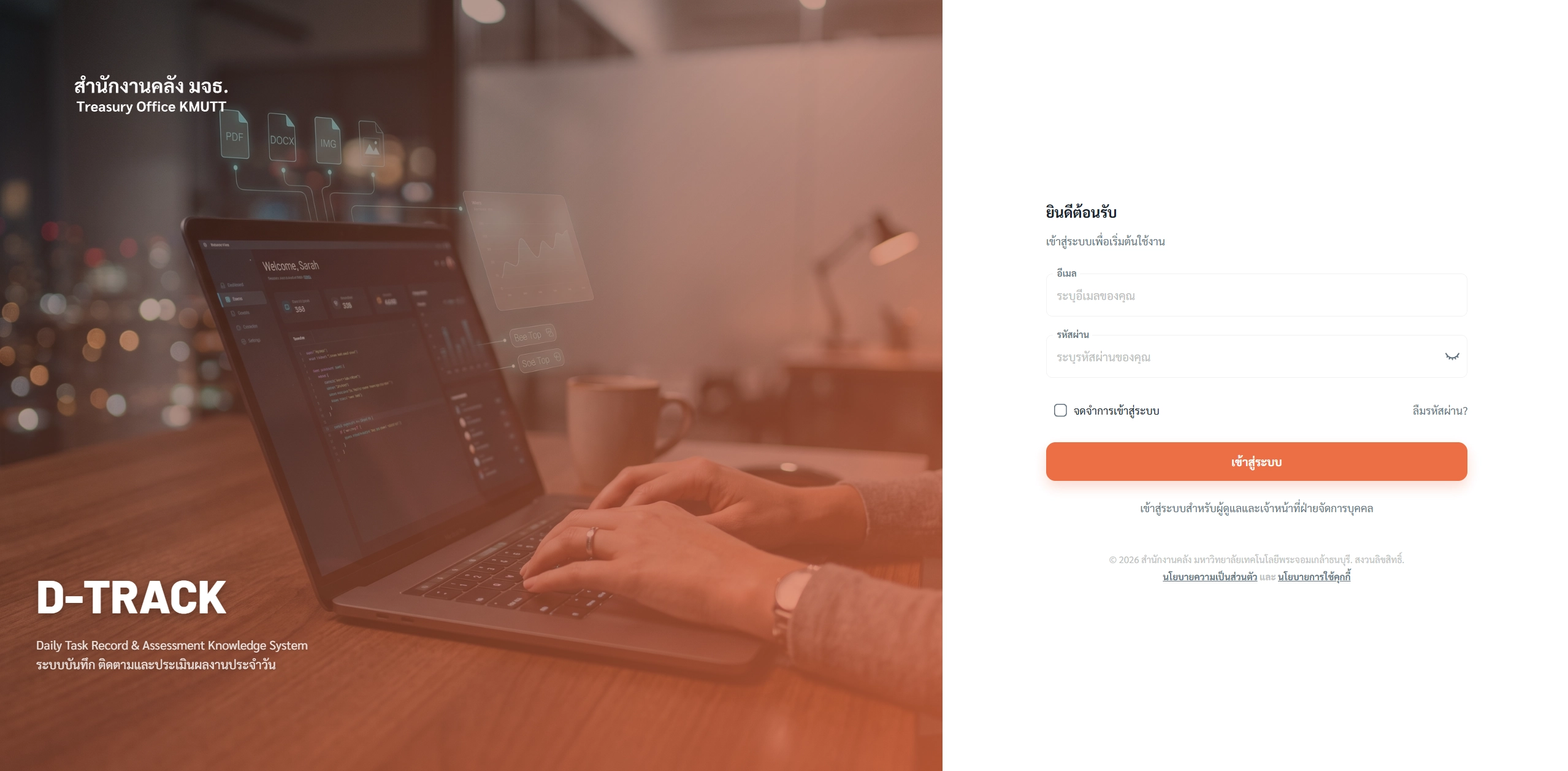
INTECH engineered D-TRACK to unify daily activity tracking directly with the division’s evaluation framework. Personnel record daily achievements by functional category in under two minutes, attach supporting documents, and submit duties for supervisory sign-off. The platform gives leadership real-time workload visibility for fair capacity balancing and automates KPI aggregation for institutional performance appraisals.
Scope of work
- Daily activity logging system recording operational categories, output quantities, hours spent, and reference links
- Domain-tailored duty categorization for university treasury operations (disbursement, general accounting, procurement, budgeting, and advisory)
- Multi-tier organizational hierarchy and role-based permissions (Staff, Team Supervisor, Division Director, System Administrator)
- Structured supervisory verification workflow with contextual review comments and revision loops
- Automated KPI mapping engine connecting daily tasks directly to formal terms of reference (TOR) agreements
- Division-wide workload distribution and team capacity monitoring dashboards
- Comprehensive audit logging capturing immutable change histories for state transitions
- Standardized export pipelines for evaluation dossiers in Excel and PDF formats
Behind the build
Operational Context at KMUTT Treasury & Finance Division
The Treasury and Finance Division of King Mongkut’s University of Technology Thonburi (KMUTT) serves as the administrative backbone for fiscal operations across all faculties, research institutes, and central directorates. On any given day, finance officers handle an intensive stream of financial transactions: reviewing disbursement vouchers, processing procurement inspects, executing vendor bank transfers, reconciling university accounts, and preparing official financial statements under strict regulatory deadlines.
Historically, the documentation of these daily responsibilities was fragmented. Officers maintained personal desk logs or individual spreadsheets to monitor their pending files. This localized approach created two persistent institutional challenges:
First, division supervisors and executives had no aggregated, real-time visibility into actual workload distribution. It was difficult to detect when a particular team was becoming overwhelmed with procurement contracts or which steps in the invoice validation chain were experiencing severe backlogs. Without objective workload metrics, rebalancing personnel across sub-departments was largely guesswork.
Second, when the annual performance appraisal period arrived (under the university’s TOR and KPI framework), officers were forced to spend extensive overtime sifting through archive folders, emails, and notes to reconstruct what they had accomplished over the preceding six to twelve months. Important supporting evidence was frequently misplaced, and the administrative burden took staff away from their primary financial duties.
The D-TRACK Solution: High Value with Low Administrative Friction
When building internal administrative software for busy financial professionals, excessive input friction leads to poor adoption. The core design philosophy behind D-TRACK (Daily Task Record & Assessment Knowledge System) was simple: logging daily work must take no longer than two to three minutes per day, while producing structured data valuable to both the employee and institutional leadership.
- Structured Operational Logging: Rather than free-form prose, the interface organizes tasks into established departmental categories—such as invoice audits, budget encumbrances, vendor reconciliations, or faculty consultations. Staff select the duty type, enter output volume (e.g., 20 disbursement packages audited), input the duration, and attach document references or cloud links.
- Hierarchical Supervisory Verification: Completed logs flow automatically to line supervisors. Supervisors can approve entries or return them with specific guidance in real time. Issues regarding incomplete documentation are addressed immediately rather than surfacing months later during fiscal year close.
- Automated KPI Mapping: Every logged task category is mapped directly to the employee’s pre-configured performance agreement (TOR). As daily duties accumulate, the system automatically tallies completed outputs and hours against relevant institutional indicators, generating an evaluation-ready performance portfolio in a single click.
- Workload Balancing & Analytics: Departmental directors access interactive capacity dashboards illustrating how hours are distributed across functional duties. This enables data-driven decisions regarding resource allocation and helps identify systemic bottlenecks before they impact university operations.
Technical Architecture & Engineering Standards
D-TRACK was engineered according to strict Clean Architecture principles, ensuring maintainability, audit compliance, and responsive performance under high-concurrency reporting deadlines.
1. Backend Service: Go (Golang) Microservice
The backend is built in Go (Golang), chosen for its fast native binary execution, minimal memory footprint, and exceptional concurrency handling. During end-of-quarter appraisal rushes, the server easily handles thousands of aggregate metric calculations without performance degradation.
The codebase strictly adheres to Clean Architecture layers:
- Domain Entities & Logic: Encapsulates the core rules of operational tracking, working-hour computations, and KPI scoring algorithms with zero external dependencies.
- Use Cases (Interactors): Orchestrates core system workflows, such as supervisory sign-offs, role-based authorization rules, and statistical aggregation services.
- Repository Layer: Interfaces with PostgreSQL using strict parameterized queries and transaction isolation levels, guaranteeing data integrity across complex state changes.
- Delivery Layer: Exposes clean RESTful endpoints with end-to-end type validation and structured error handling.
2. Frontend Application: Next.js + Material UI (MUI) + Tailwind CSS
The client-side interface balances administrative rigor with responsive modern UX:
- Next.js: Leverages modern SSR capabilities for high-speed dashboard loading and smooth client-side page transitions, providing a fast, desktop-grade user experience.
- Material UI (MUI): Employed for complex, data-heavy enterprise UI patterns where accessibility and form fidelity are paramount. This includes multi-column sortable Data Grids, date-range selectors, searchable autocompletes for institutional account codes, and modal confirmation dialogs.
- Tailwind CSS: Utilized alongside MUI to manage layout composition, responsive grid systems, consistent spacing tokens, and typography. The color palette follows a clean, restrained executive palette matching KMUTT’s institutional dignity.
Security, Governance, and Audit Readiness
Because D-TRACK directly informs personnel appraisals and civil service merit evaluations, data integrity and accountability are paramount:
- Immutable Audit Ledger: Every state change—from initial draft entry to supervisory verification and administrative revision—is permanently recorded in a dedicated audit log with user identity, previous state, and millisecond timestamps.
- Strict Role-Based Access Control (RBAC): Access privileges strictly mirror organizational hierarchy. Staff can only access their own logs; supervisors manage their direct teams; and department leadership views anonymized or aggregated divisional metrics.
- Evaluation Period Freezing: At the conclusion of an appraisal cycle, administrators can lock the corresponding date range, preventing retrospective alterations to historical performance records.
Project gallery
Outcomes
- Reduced the time required to compile evidence before annual appraisal reviews from several days to minutes
- Equipped division leadership with live insight into operational capacity, backlogs, and workflow bottlenecks
- Established an auditable and transparent operational record aligned with university governance standards
- Promoted equitable workload distribution across teams based on empirical duty data rather than subjective estimates
Technology
- Go
- Next.js
- Tailwind CSS
- MUI
- PostgreSQL
- Docker